Overview of Italy, France and Spain rules requiring mobility managers, commute plans, and the data needed to comply.

If you run large sites in Italy, France, or Spain, you should check scope first. A site may need a mobility lead, a commute plan, formal staff talks, or all three. The hard part is usually not naming a person. It is proving, with data, how people travel to work and which actions make sense before money is spent.
Here’s the article in one view:
| Country | Main rule | What employers may need to do | Trigger to check |
|---|---|---|---|
| Italy | PSCL framework | Appoint a Corporate Mobility Manager and prepare annual travel plan | Qualifying site rules; confirm with local counsel |
| France | LOM | Negotiate commuting issues; create Employer Mobility Plan if no agreement | 50+ employees on one site |
| Spain | Law 9/2025 | Appoint Mobility Manager and put in place a commuting plan | Site-based and shift-based tests |
Treat this as a site-by-site exercise, not a country-only one. That is the simplest way to turn a legal duty into a work plan your teams can actually run.
Each country sets its own trigger points, so check scope before you assign ownership. Scope comes first. The role only becomes active when a site falls within the rules. Once you've mapped where each rule applies, the next step is simple: figure out what the mobility manager is expected to deliver.
Under Italy's PSCL framework, qualifying employers must appoint a Corporate Mobility Manager and prepare a home-to-work travel plan for eligible sites.
France's Mobility Orientation Law (LOM) takes a negotiation-first approach. At sites with at least 50 employees, commuting must be part of the mandatory annual negotiations. If no agreement is reached, you must produce an Employer Mobility Plan.
Spain's Law 9/2025 requires large worksites to implement a Sustainable Commuting Plan and designate a Mobility Manager. Headcount alone does not trigger compliance. The law sets site-based and shift-based triggers, so review the exact thresholds and shift definitions in Law 9/2025 with local counsel before deciding which Spanish sites are in scope. Conducting a mobility audit can help clarify these requirements by providing the data needed for compliance.
| Country | Key Law | Core Obligation | Trigger |
|---|---|---|---|
| Italy | PSCL framework | Appoint Corporate Mobility Manager; prepare home-to-work travel plan | Eligible site criteria, verify with counsel |
| France | LOM | Include commuting in mandatory annual negotiations; produce Employer Mobility Plan if no agreement | At least 50 employees on a single site |
| Spain | Law 9/2025 | Designate Mobility Manager; implement Sustainable Commuting Plan | Site-based and shift-based triggers |
Those trigger points shape who owns the plan, which sites fall in scope, and what evidence you need to keep on file.
Once you know which sites are in scope, the next step gets practical: what does this person actually own? The title can sound admin-heavy, but the job comes with day-to-day accountability.
The first job is to assess current commuting patterns and set a site-level baseline. That baseline gives you the starting point. Later, it becomes the reference point for judging whether your measures are working.
From there, the role moves well beyond writing a plan. Your mobility manager needs input from HR, operations, facilities, sustainability management, and finance. Then they have to turn legal expectations into a commuting programme those teams can actually back and help deliver.
In some countries, the role also involves working with worker representatives and public authorities. That part often gets overlooked at the start. On paper, the role may seem simple. In practice, a lot of the work sits in coordination, follow-up, and getting different teams to move in the same direction.
The plan itself is only one piece of the puzzle. Leadership and regulators will usually expect a set of linked outputs that show the work is being managed, tracked, and updated.
That usually includes:
Those outputs depend on one thing first: you need a solid model of commuting patterns.
Naming a mobility manager is straightforward. Giving that person a defensible evidence base is the hard part.
The duty may come from law, but the place things often break is day-to-day work: missing data.
Commuting data usually sits in different places across the business. HR may hold employee home addresses. Operations may manage shift schedules. Facilities may track site records.
Trying to pull that together by hand often leads to a mess: fragmented site data, old employee location inputs, and survey responses you can't lean on with much confidence. And without one shared view, you can't properly test measures or back up your priorities.
The problem gets worse when a company runs across multiple sites, countries, and shift patterns. A plan that fits one office can fall apart at an industrial site with early, late, or rotating shifts. Public transport timetables may simply not line up with the way people work.
Without shift-level visibility, you're planning on guesswork instead of a defensible picture of how employees actually travel.
A commute model brings employee postal codes, site data, and shift patterns into one baseline for how people travel and where the gaps are.
That baseline matters. You need it before you can simulate measures or decide where to put budget.
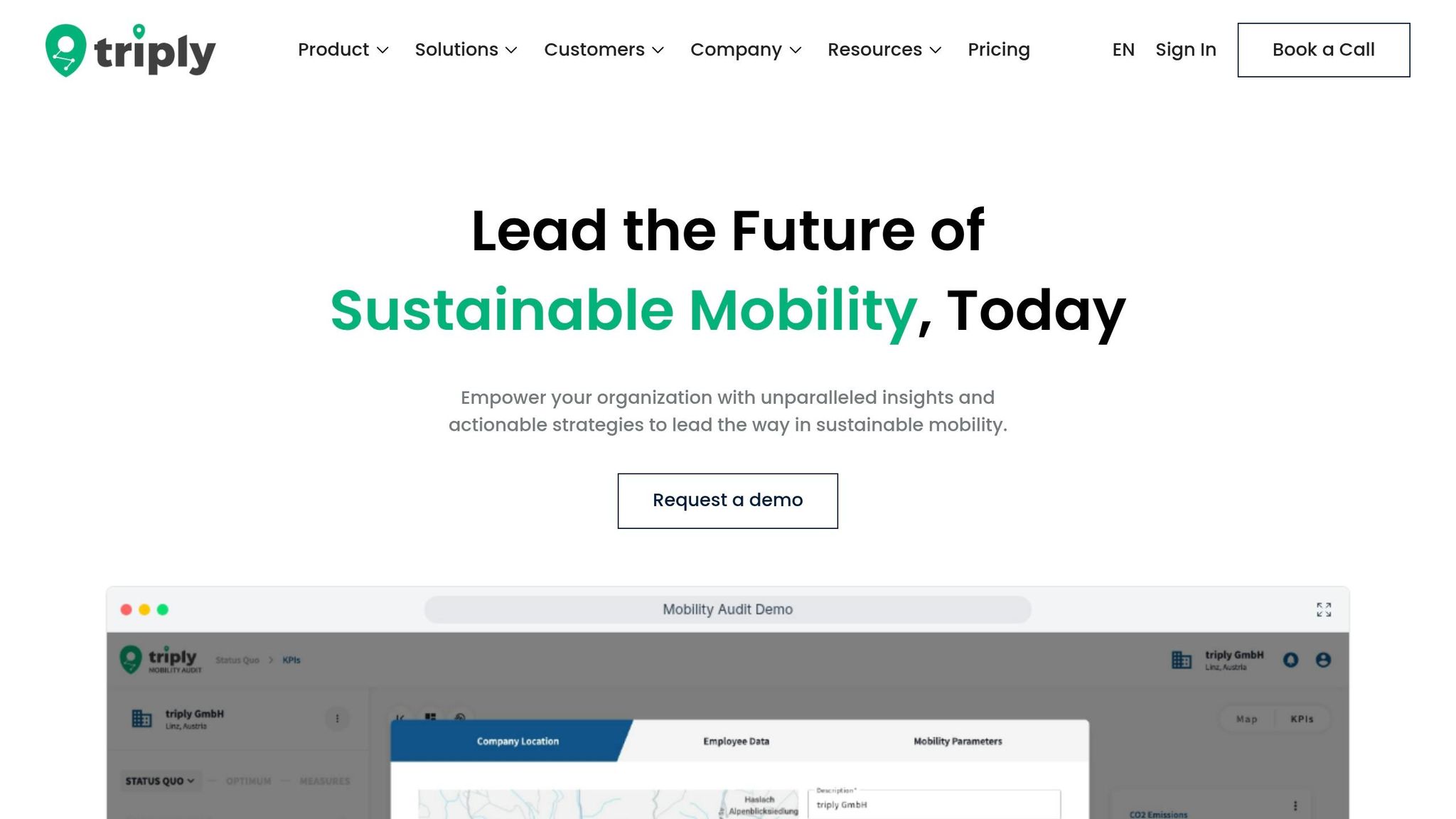
triply turns the commute model into a working process. That baseline helps you go from a legal duty to a plan people can actually use.
Across Italy, France, and Spain, the first question is the same: what do employees actually do to get to work?
It starts with data you already have: employee postal codes and shift patterns. triply uses that input to model real commuting patterns across every site, without asking you to survey your full workforce. The result is a site-level commute baseline you can use to build the mobility plan.
You can then use the model to test whether a shuttle route or a public transport incentive is likely to shift enough employees to make the spend worth it. Before you commit budget, you can compare load factor, cost per boarded rider, and Scope 3 Category 7 emissions.
For employers with multiple sites, the combined view matters. Instead of running separate analyses for each plant or office, mobility, HR, operations, sustainability, and finance can work from one shared evidence base. That makes cross-functional coordination less of a back-and-forth and more of a clear next step.
The same data also supports reporting. triply produces audit-ready Scope 3 Category 7 outputs aligned with CSRD and ESRS E1, so your mobility manager can show progress without having to rebuild the evidence trail later.
Sustainable mobility laws across Europe are turning commute planning into a formal employer duty. The mobility manager role comes with real cross-functional accountability, and legal frameworks now call for structured plans, documented diagnoses, and measurable outcomes.
Naming someone to the role is the easy part. Giving them the data, the simulation tools, and the reporting outputs to do the job well is where many large employers need help.
Book a demo to see how triply maps your sites and shift patterns.
Please note: this article is general information only and does not constitute legal or tax advice. Consult qualified legal counsel for guidance specific to your jurisdiction and situation.