Turn employee commute data into site-level cost, emissions baselines and test transport measures before budgeting.

A mobility audit shows, in one view, how your employees travel to work, what that costs, and what it adds to Scope 3 Category 7 emissions. If you run several sites, it helps you move from rough guesses to a clear commute baseline built from employee postcode, site, and shift data.
In plain terms, we’d sum it up like this:
That’s the core idea. A mobility audit is not a full ESG report, and it does not cover freight or your whole company footprint. It sits earlier in the process: first you map commuting, then you estimate cost and emissions, then you model measures.
A few points stand out:
If we had to reduce the article to one sentence, it would be this: a mobility audit turns commute data into a working basis for cost, emissions, and measure planning by site.
In corporate commuting, a mobility audit shows how employees travel between home and worksite and turns that input into a site-level baseline for cost, emissions, and action. The focus is narrow on purpose: employee commuting only. It does not cover your broader ESG footprint or freight network.
The outcome is a verifiable picture of commuting across your sites. That matters because it gives teams one clear view of what is happening on the ground, instead of rough assumptions.
Because the audit converts commute data into a baseline, it sits upstream of both reporting and investment decisions. In plain terms, it gives you the numbers and modelling logic to test measures before money is spent.
That’s not the same as a sustainability report or ESG disclosure. Those usually come after the analysis. The audit comes first. It gives you the basis for deciding what to test, where to act, and what the likely effect could be.
The value goes beyond reporting. On the operational side, a mobility audit shows where costs and emissions are concentrated. Scope 3 Category 7 covers emissions from employee commuting, including travel by private car, public transport, and other modes between home and worksite.
For large multi-site employers in Germany, CSRD can make Scope 3 emissions part of the evidence base you need. Without site-level evidence, decisions about commuting measures rest on guesswork. With that evidence, finance, sustainability, HR, and operations can work from one credible data set.
That’s why the audit starts with anonymised employee location, site, and shift data.
Once you’ve defined what a mobility audit is for your organisation, the next step is simple: collect the minimum data needed to make the baseline believable.
For a solid first baseline, you don’t need a mountain of inputs. You need a small, focused set of internal data and a clear way to mark assumptions when data is missing.
The minimum internal inputs are pseudonymous employee IDs, home location at PLZ level, worksite location, planned attendance, and shift start and end windows. That’s enough to build a first baseline.
Using pseudonymous IDs helps reduce unnecessary collection of personal data. It keeps the audit grounded in what’s needed, without pulling in more employee information than the job calls for.
Shift patterns also matter more than many teams expect. A site with several start and end windows creates a very different commuting picture from a standard office with one common schedule. So the audit needs to show when people are on site, not just how many people work there.
If some commute details are missing, label those inputs clearly as modelled and keep them separate from observed data. Every output based on assumptions should also be flagged as modelled.
That distinction matters. Otherwise, a modelled estimate can look like a measured fact, and that can skew later cost, emissions, and measure planning.
With these inputs in place, the audit can build a baseline that supports cost, emissions, and measure modelling.
triply's mobility audit gives you three main outputs: a commute baseline, cost and emissions estimates, and modelled measures. Put together, these turn raw commute data into something you can actually use for decisions.
The baseline is the first clear output. It groups commuting data by site, shift, business unit, and transport mode. So you can see where employees are coming from and how they get to work.
That gives you a site-level view of commute patterns that's ready for planning. It also becomes the starting point for cost estimates, emissions estimates, and scenario modelling.
Once the baseline is in place, you can turn it into cost and Scope 3 Category 7 emissions estimates. That gives you one consistent basis for assessing the financial side of commuting and Scope 3 Category 7 employee commuting emissions by site and business unit.
You can use these estimates for internal decision-making and reporting support.
The baseline also lets you test measures before putting money behind them. You can simulate what happens if you change something, such as:
Each simulated measure shows an expected uptake range, a relative cost impact, and an emissions effect before you commit budget. Because every scenario uses the same underlying commute model, you can compare options on a like-for-like basis and talk them through with finance and operations.
These scenario outputs then feed the budget and reporting decisions that follow. From there, you can use the outputs to support budget and reporting decisions.
Once you have the baseline and the modelled measures, you can decide where to act first.
Treat the audit output as one shared data set for mobility, finance, sustainability, and operations. That gives everyone the same starting point and helps teams line up on budget before any money is spent. Finance can compare measures across sites using the cost impact estimates and see where the business case is strongest. Sustainability and operations can use the Scope 3 Category 7 outputs for CSRD and ESRS E1 reporting. This is general information, not legal or tax advice.
Sites rarely work the same way. Some run different shift patterns, some have different travel needs, and some face limits that others don't. The baseline makes those differences clear. That matters because it lets you match each measure to what can actually work at a given site, instead of forcing the same standard plan everywhere.
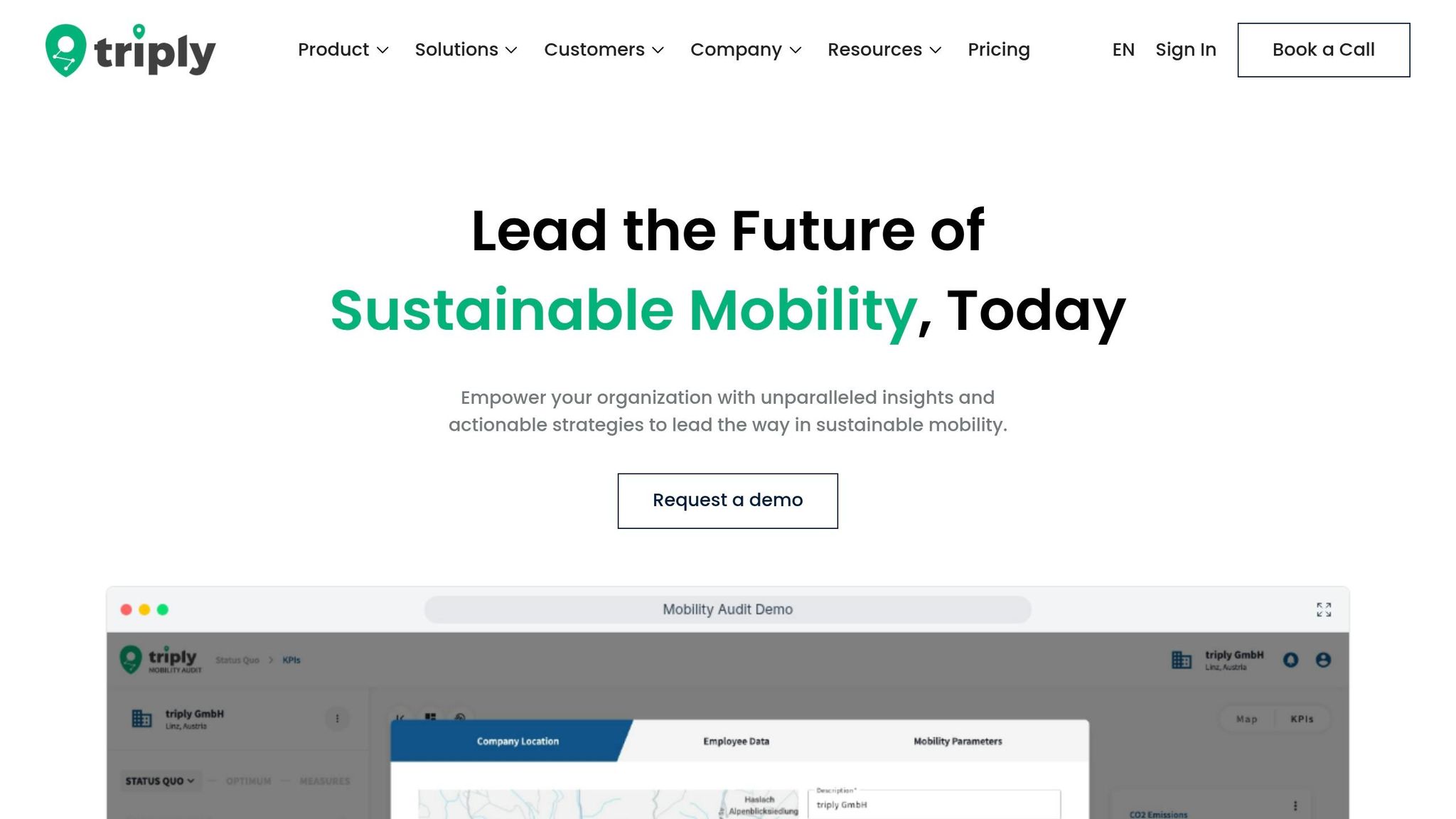
triply turns your commute data into a site and shift baseline, internal cost and emissions estimates, and comparable modelled measures.
If shuttle planning is part of your response, you can use that same commute model for the next step. If you manage employee shuttle operations, use employee shuttle optimisation to carry the same commute model into planning.
Book a demo with triply to see how a mobility audit would work for your sites using your actual commute data.
The provided content does not answer this question.
Based on the text you shared, no timeframe for a mobility audit is given. So the duration can't be clarified without adding information that isn't in the source.
Yes. In a mobility audit, employee data should be handled in a way that protects personal information while still letting you build a commute baseline, assess cost and emissions, and model measures.
Modelled commute estimates give you a solid baseline for planning. How close they are depends on the data used in the mobility audit - including commute patterns, site context, and the measures being modelled.
They’re useful for comparing likely effects on commute patterns, cost, and emissions. This is general information, not legal or tax advice.