Model commutes site-by-site and test shuttles, transit passes, carpools or flexible hours to cut costs and Scope 3 emissions before investing.

Most employee transport schemes fail for one simple reason: companies fund them before they test likely uptake. If you want lower commuting cost and lower Scope 3 Category 7 emissions, start with a site-by-site model before spending €1.
Here’s the short version:
A shuttle with a 50% load factor can get expensive fast. A transit subsidy can waste money if staff already use public transport. And a carpool plan can stall if shifts do not line up. That’s why the right question is not “Which benefit is best?” but “Which one works for this workforce, at this site, on these shift times?”
Quick comparison
| Measure | Best fit | Main risk | What to check first |
|---|---|---|---|
| Shuttle | Dispersed staff, fixed shifts | Low occupancy | Load factor by corridor |
| Transit subsidy | Good rail/bus access | Deadweight spend | Share of staff already using transit |
| Carpool support | Similar routes and hours | Poor matching | Shift overlap and route overlap |
| Flexible hours | Teams with timing freedom | Coverage gaps | Staffing limits on site |
Bottom line: Choose transport benefits by measured impact, not assumption. That means building a baseline first, then testing likely behaviour change before rollout.
Once you know why employee transportation benefits often miss the mark, the next step is simple: figure out which measure has the best shot at working at your site.
The right comparison looks at commute fit, likely uptake, operating effort, and cost per boarded rider. That matters because the same benefit can work well in one place and flop in another.
Shuttles tend to fit dispersed workforces and shift-based start times. But there’s a catch: they need enough riders on board to make the operating cost worth it. If buses run half empty, the maths gets ugly fast.
Transit passes can work well when public transport already serves your site. But they can also create deadweight loss. If most employees already travel by rail or bus, you may end up paying for behaviour that was happening anyway.
Carpool support can cut Scope 3 Category 7 emissions at a low operating cost. On paper, that sounds hard to beat. In practice, matching often falls apart when shift times vary too much or people’s routes don’t line up.
Flexible hours can ease pressure during peak commute periods. That helps, especially where congestion is part of the problem. Still, they don’t replace actual transport when roles need fixed staffing on site.
So there isn’t one measure that wins everywhere. The best choice is the one that fits your site’s shift patterns, where people live, and the limits of your service set-up.
This comparison only means something if you test it against your own commute data and shift structure.
A measure works only when site geography, shift times, and workforce distribution support regular use. That’s the core idea. Without that fit, even a low-cost option can underperform.
Here’s what that looks like in practice:
These are the modelling inputs you’ll use in the next section to stress-test each option before you commit budget. The next step is to model uptake with the minimum data needed for a decision-ready simulation.
After you compare measures based on site fit, one thing still has to happen before rollout: you need a measured baseline.
That part gets skipped all the time. A company picks a shuttle, subsidy, or lease-bike plan that looks right on paper, then expects cost and emissions gains to follow. But even a good idea can miss its targets if no one has pinned down how employees commute today.
Before rollout, track four metrics: load factor, cost per boarded rider, modal split, and Scope 3 Category 7 emissions.
These four give you one shared way to judge whether a measure fits your site. But they only help if they're tied to actual commute data. Otherwise, you're comparing guesses.
A baseline puts everyone on the same page. It replaces competing assumptions with one set of numbers that people can work from.
It should show:
That baseline becomes the reference point for your business case.
A survey can support that baseline, but it can't replace it.
Commuter surveys are useful. They can show intent, preferences, and pain points. The problem is that they age fast. People move. Shift patterns change. Travel habits change too. And surveys often don't give the route and timing detail needed to plan shuttle routes or judge public transport fit.
That creates a problem for rollout decisions. If you rely on stated intent instead of actual commute geography and shift structure, you can end up funding the wrong measure.
It also makes surveys tough to defend as the only source for Scope 3 Category 7 reporting under CSRD and ESRS E1 (European Sustainability Reporting Standard on climate). This is general information, not legal or tax advice.
Start with HR and operations data. In most cases, that gives you enough to build a model that’s actually useful. Use surveys only where something is missing.
The main inputs are usually already sitting in your systems:
Postal codes are enough to map where your workforce is based for each site, without relying on exact home addresses.
Once the model is in place, compare each measure using the same set of outputs:
| Output | Decision value |
|---|---|
| Projected uptake | How many employees are likely to switch to the proposed measure |
| Load factor | Expected occupancy on shuttles or shared vehicles |
| Cost per boarded rider | Whether the measure is financially viable at realistic demand |
| Effect on parking demand | How much pressure is relieved at each site |
| Scope 3 Category 7 impact | Estimated emissions reduction against your baseline |
This matters because a shuttle route with a low load factor gets expensive fast. A simulation helps you spot those mismatches before any money goes out the door.
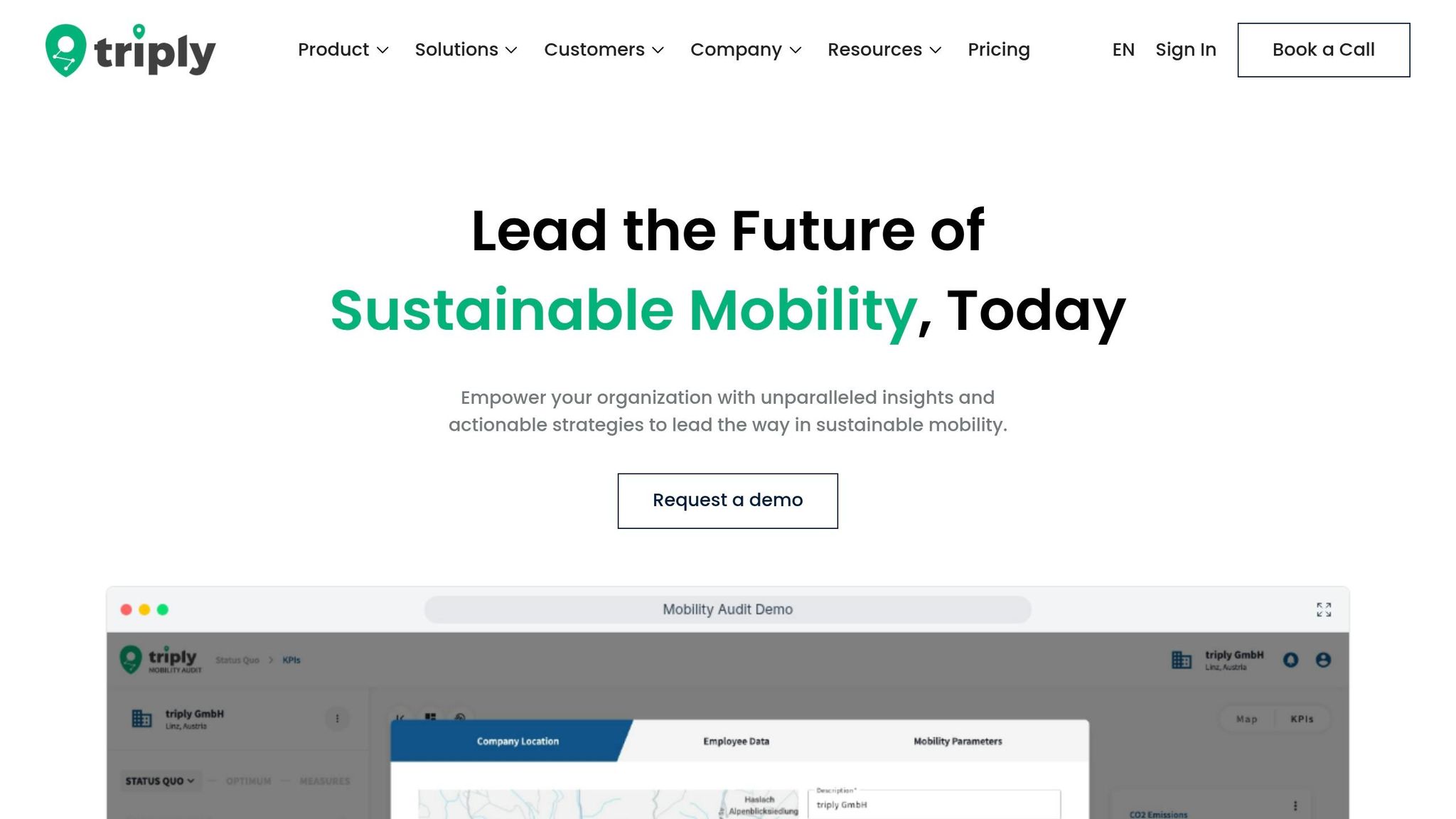
triply models real employee commutes from minimal data and simulates shuttles, public transport incentives, carpooling, and schedule changes before you commit budget. That means finance, operations, and sustainability can all work from the same numbers, including audit-ready Scope 3 Category 7 outputs for CSRD and ESRS E1 reporting.
For a closer look at how route design, timing, and stop placement interact with actual commute geography, see triply's employee shuttle optimisation capability.
Use the scenario results to compare each measure on cost, emissions, and site fit before you build the business case. That gives you the evidence you need for the internal business case in the next section.
Once you compare the options and model likely uptake, the next step is pretty simple: pick the one that shows clear impact at your site. Employee transportation benefits only cut cost and emissions when they fit your location, commute catchment, and shift setup. If you skip the modelling, you're making a bet. And that can mean paying for measures that look good on paper but fall flat in practice.
Start with a baseline before spending anything. You need to know where employees travel from, how they commute today, and what your current Scope 3 Category 7 emissions look like.
Then compare each option with the same set of metrics. That means projected uptake, load factor, cost per boarded rider, parking demand relief, and emissions impact. If each option uses different assumptions, the comparison falls apart. A shared commute model gives Finance, Operations, HR, and Sustainability one consistent data set to work from.
Test uptake before rollout. If the model shows a low load factor, that's not bad news. It's a useful signal to pause before signing a contract and locking in spend.
If you need a site-specific answer, model the commute before you fund the benefit. triply models real employee commutes from minimal data and simulates measures before you invest. Book a demo of employee shuttle optimisation modelling to see how pre-investment commute modelling applies to your sites.